Required and recommended reading 3.3.1

Required reading Lifestyle Medicine 3rd Edition Chapter 18 – To Sleep, Perchance to… Get everything Else Right (West & Egger, 2017) Recommended reading Elevated inflammatory markers in response to prolonged sleep restriction are associated with increased pain experience in healthy volunteers (Haack et al., 2007) About sleep’s role in memory (Rasch & Born, 2013) Brain […]

Learning outcomes 3.3.1

3.3.1 Sleep Physiology – Introduction Describe the physiology of sleep Identify how sleep deprivation impacts health Describe what a good night’s sleep looks like Describe the drivers of sleep 3.3.2 Factors that influence sleep Summarise the role of light exposure, circadian rhythms and hormones on sleep 3.3.3 Sleep quality Describe the impact current lifestyle and […]

Presentation 3.2.4

Presented by Dr Joanna McMillan, BScNutr &Diet (Hons), PhD, FASLM Download the slides for this presentation here: Nutrition science vs popular beliefs – Myth-busting Presentation

Presentation 3.2.3

Presented by Dr Sue Radd-Vagenas, BSc, GDD, PhD, Advanced APD, FASLM Download the slides for this presentation here: Nutrition prescription – Introduction Presentation

Required and recommended reading 3.2.3

Required reading Nutrition prescription made simple (Wetherill et al., 2019) Recommended reading Effectiveness of behavioural weight loss interventions (Booth et al., 2014) Australian Dietary Guidelines Educator Guide: Information for nutrition educators – Chapter 2 provides a useful overview of the nutritional characteristics of the Australian Guide to Healthy Eating five food groups (main distinguishing nutrients […]

Required and recommended reading 3.2.2

Required reading Nutrition prescription made simple (Wetherill et al., 2019) Recommended reading The NutComp Tool (Healthy Primary Care, n.d.). Test your nutrition competence and identify possible areas for improvement. SNAP: Population health guide to behavioural risk factors in general practice – The 5As: Section 2.1 and Section 3.3 (RACGP, 2015) Nutrition assessment: REAP and WAVE: New […]

Additional resources 3.2.1

Dietary guidelines Webpages Food-based dietary guidelines (Food and Agriculture Organization of the United Nations (FAO), n.d.). This page provides a link to all countries worldwide that have developed dietary guidelines and adapted it to their nutrition situation, food availability, food cultures and eating habits. Patient resources How to measure portion sizes with your hands (infographic) (European […]

Presentations 3.2.1

Presented by Dr Flavia Fayet-Moore, BSc(Hons), MNutrDiet, RNutr, APD, PhD, Dr Joanna McMillan, BScNutr &Diet (Hons), PhD, FASLM and Dr Sue Radd-Vagenas, BSc, GDD, PhD, Advanced APD, FASLM Download the slides for these presentations here: Dietary guidelines Nutrition assessment Nutrition prescription Nutrition science vs popular beliefs – Myth-busting Dietary guidelines Dietary assessment Nutrition prescription Nutrition […]

Required and recommended reading 3.2.1

Required reading Dietary guidelines Lifestyle Medicine 3rd Edition Chapter 8 – Nutrition for the nondietitian (McMillan-Price & Egger, 2017) Nutrition assessment no required reading Nutrition prescription Nutrition prescription made simple (Wetherill et al., 2019) Nutrition science vs popular beliefs no required reading Recommended reading Dietary guidelines Australia Australian dietary guidelines (N55) (NHMRC, 2013a) Australian Health Survey: […]

Learning outcomes 3.2.1

3.2.1 Dietary Guidelines Summarise the dietary guidelines, and describe why they are important Describe nutrition basics – foundation diet, total diet, energy and nutrient requirements, basal metabolic rate and physical activity levels to maintain health Describe the food groups and the key macronutrients and micronutrients obtained from each of the food groups Describe the nutritional […]

Subscribe to our our Newsletter

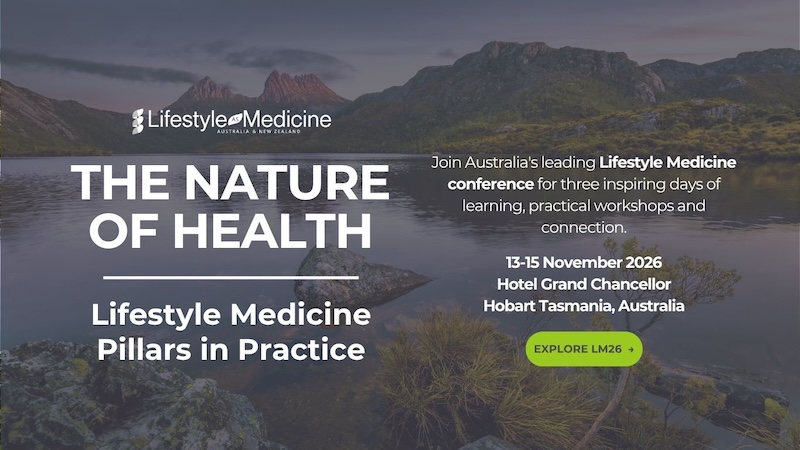
LM26 CONFERENCE

EARLY BIRD ON SALE NOW

Join us in Hobart for our annual Lifestyle Medicine conference as we explore how green and blue spaces, social connection, and the six pillars of Lifestyle Medicine can transform clinical and community care.

Register before 30 June 2026 to secure the last chance at a discount