Additional resources 3.5

Articles Can’t go outside? Even seeing nature on a screen can improve your mood (Brack & Ghazalli, 2020) Websites The Lift Project: Lift your mood and your life (The Lift Project, n.d.) Books Live more happy: Scientifically proven ways to lift your mood and your life (Morton, 2018) Relevant to this topic: Chapter 4: Blue […]

Presentation references 3.5

Benfield, J. A., Rainbolt, G. N., Bell, P. A., & Donovan, G. H. (2015). Classrooms with nature views: Evidence of differing student perceptions and behaviors. Environment and Behavior, 47(2), 140-157. https://doi.org/10.1177/0013916513499583 Block, M., Stern, D. B., Raman, K., Lee, S., Carey, J., Humphreys, A. A., Mulhern, F., Calder, B., Schultz, D., Rudick, C. N., Blood, […]

Presentation 3.5

Presented by Dr Cheryl Wilson Download the slides for this presentation here: The health benefits of nature and social inclusion Presentation

Learning outcomes 3.5

Explain the importance and effects of nature on health Describe the health benefits of social inclusion Create a nature and social intervention prescription

Additional resources 3.4

Articles Psychological well-being revisited: Advances in the science and practice of eudaimonia (Ryff, 2014) Final recommendation statement – Depression in adults: Screening (US Preventive Services Task Force (USPSTF), 2016) Videos The secret to living longer may be your social life (15:56 minutes) (Pinker, 2017) How to live to be 100+ (19:31 minutes) (Buettner, 2009) Links may […]

Presentation 3.4

Presented by Dr Kate Gregorevic, BSc, MBBS(Hons), FRACP, PhD Download the slides for these presentations here: Salutogenesis – Part A Salutogenesis – Part B Salutogenesis – Part C Salutogenesis – Part D Part A Part B Part C Part D

Recommended reading 3.4

Recommended reading Carol Ryff’s model of psychological well-being: The six criteria of well-being (Living Meanings, n.d.) Positive health and health assets: Re-analysis of longitudinal datasets (Seligman et al., 2013) Links may expire – If you find any links are not working, please let us know via info@lifestylemedicine.org.au.

Learning outcomes 3.4

Describe a salutogenic approach to health  Demonstrate how positive emotions impact health  Describe the negative relationship between positive emotion and inflammation  Describe the practitioner’s role in facilitating the patient’s positive emotions  Demonstrate how to apply a salutogenic approach when assessing a patient

Additional resources 3.3.1

Websites Sleep Health Foundation Australasian Sleep Foundation Books Why We Sleep: Unlocking the power of sleep and dreams (Walker, 2018). This book is highly recommended, especially if you think you are too busy to get enough sleep. The Sleep Solution: Why Your Sleep Is Broken and How to Fix It (Winter, 2017) Reports Re-awakening Australia: […]

Presentations 3.3.1

Presented by Dr Jenny Brockis Download the slides for these presentations here: Sleep physiology – Introduction Sleep physiology – Factors that influence sleep Sleep physiology – Sleep quality Sleep physiology – Common sleep disorders Part A – Introduction Part B – Factors that influence sleep Part C – Sleep quality Part D – Sleep disorders

Subscribe to our our Newsletter

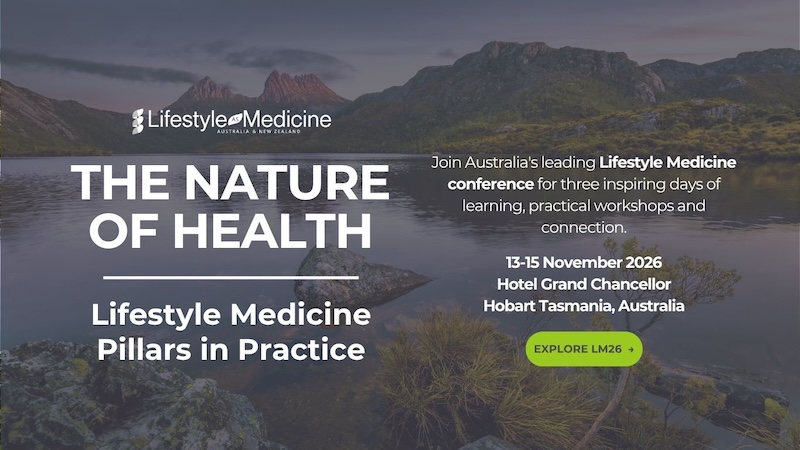
LM26 CONFERENCE

EARLY BIRD ON SALE NOW

Join us in Hobart for our annual Lifestyle Medicine conference as we explore how green and blue spaces, social connection, and the six pillars of Lifestyle Medicine can transform clinical and community care.

Register before 30 June 2026 to secure the last chance at a discount